24:10



There's something clearly distinct about a wild place that is hard to describe. But after one year of hard work, I think we've got it. It's the effortless beauty, the excitement of exploration, and the unique feeling of simply not knowing what you will find. This place has changed. I'm really excited to see the project area, especially, you know, to see how the corals have grown, if I can recognize any, and the marine life that has moved in. But before we do that, we need to catch up with the progress that
the team has made. So, we're going to go for some uh deployment dives to see the new techniques that they are experimenting with. And some of these ideas came from you and they are really interesting. One of these points of feedback was whether we could add some more structural height diversity. And to try this out, the team created a new type of structure. Yeah. So this is the hexagonal structures, the one that uh we currently use. And this is the adaptations of it, the dome-shaped uh structures that we are going to use today. And this is these are the new ones, the new models. So basically the base are very similar with a similar angle. So they can uh interlock a little bit with each other and the only
difference is the uh height of the structure. So this is a little bit uh archy at the top to create um a diversity on the structures of the habitat. Basically their additional height and dome-l like shape will also be quite useful for slower growing corals. But more on them in a bit because now we need to go deploy these. The team here at our Wilder Reefs project consists of Yudian Chansa who manage the project, Haden Reza, who are contracted as divers and of course our captain Pakadek. And to complete the picture, we have the newly renamed Domino. I'm really happy with how this turned out and that it's not some sort of terrible name, but instead a lovely dedication to the first inhabitant of
our reef. A good name for the sturdy boats that makes all of this possible. We've changed up the system a bit and these days the metal shop does both the metal work and the coating for us as it is more efficient and saves time and transport costs and the deployment of these has also changed a bit. Now they are dropped in rather than being carried down which makes more sense. Once they are down there the team gets busy organizing them in the correct arrangement and tying them together with metal zip ties and aluminium wires. These are the new materials that have replaced plastic zip ties to connect the structures together. And as the team was building this new part of the reef, I
noticed that they were not the only ones in a building mood. This is a mantis shrimp that was digging itself a nice little hole. I was really glad to see it because it is one of my favorite animals to see underwater. I mean, look at those mesmerizing eyes with the best vision on Earth. And the cool spins and flashes of their colorful tail. They are brilliant. So, the thought of having them around our reef makes me quite excited. You saw the menty shrimp? Yeah. Crazy. Really cool. When we think about it like we are trying to connect the structure with the metal structure like at the habitat and then actually the manuscript when they dig the hole they also looking for a robot that match what they need to create the hole. And
now that we have all the structures in place it is a matter of attaching the coral. As usual, this involves foraging the nearby reef for naturally broken coral fragments that the team gathers and then puts in these baskets to bring to the site. Once we have enough, we start attaching. And you'll notice that we are using aluminum wires for this as well. And it turns out that they are bendy enough to tie down most corals without breaking them. And they also seem to be okay for the coral to attach. So, this really could be our silver bullet. For now, we still want to continue using plastic zip ties a bit longer while we run a fully controlled attachment trial to test this out thoroughly. But it looks like we might
actually be able to cut out plastic from almost all of this reef building process, which would be really cool and something that I personally find really important. And I know many of you also think that way. And for more updates on this, you can keep an eye out for Yudi's vlogs on the Mossyear Fieldnotes channel where we post regular updates on our projects. I'm sure something will pop up there in the next few months. Then when it comes to the coral mix, we're also changing tactics here. Do I look like Squid? No, you don't look like Squidgy. You look very good. So now we attach corals as a one genus in a one structure and we grouping them as a cluster close to each other and later it will be minimizing competition
between the genus and easier for them if they break in case uh if there's any stressors like wave action they can probably they can easily reattach because they have like bigger colony. This makes sense because in a natural reef, you often find coral in larger colonies or at least clusters rather than in mix of species in a small space. So to mimic this to some extent and to give the slow growers a chance, we will make clusters of at least one, but sometimes even more structures all with a single genus. So for me, those taller structures don't look that much taller at this stage. So maybe that's something that we will fix in the next batch. But
the area is already looking really cool and I think it will be especially interesting to see how this new approach with the species mix will look like after a few months compared with the first site where we had these uh structures that were more like a bouquet of flowers with this mix of corals. What became clear over the course of my visit is that our crew here has become a very efficient team. They're finding improvements in everything from the materials they use to the deployment techniques or even the diving schedules and the lunch containers. Every bit counts when you are optimizing a process like this. And this has allowed them to deploy more than 3,300 structures by
now. It is hard to convey just how impressive these newly made reefs look in terms of their size, but I hope these videos give you a bit of a sense. And that is despite all the various challenges that the team has faced. There are the algae that compete with the coral and need to be scrubbed off in the first few months after deployment. And we even had a strange alol bloom that completely covered our project area, but seemed to thankfully not affect the corals directly. Then the rainy season brought the challenge of higher energy storms and plenty of rain. Also, I got to experience this one of the days we went out and can definitely attest that things get rough out there.
But oddly, when you finally get underwater, it feels wonderfully warm and cozy to be there sheltered from the storm. And I really enjoyed looking up and seeing the rainfall from below. It was actually really soothing. But on some of these stormy days, the waves caused some natural damage to the reef, which given its fragility, the team tried to fix. It also brought a lot more plastic into the area. It runs off from the nearby islands and we of course tried to collect it whenever possible. But there were also some positive signs of the increased resilience that this reef has already. You see, these storms would have been one of those moments when the loose rubble would slide down
and destroy more coral further down. However, this time our project area held this down. The rubble was held in place by the big net of structures that we have put there, which is some immediate validation that our work not only creates new reefs, but also protects the existing ones. And then the final challenge we've been facing is the Drupella snail. I was following Yudi around when he gave me this sign and pointed to one of these drupella snails. It really confused me and I had to ask him later why this would be the sign for the drupella. and his answer is classic UDI stuff. So now I'm curious whether you can guess it. So please write your best theories in the comments and we
will reveal it down there eventually. So the thing with the Drupella is that much like a boring manicured garden, our project area has to be kept snail free. They will be more than welcome once the area is established fully of course but for now they would kill some of the smaller fragments and we want to avoid this extra mortality factor to save some of the effort in replacing them and like this through the months the work has carried on with a mix of monitoring cleaning and new deployments in what feels like a balanced but efficient process and to do all of this work we have invested around 3.3 billion Indonesian rupia so far, which sounds
like a lot more than it is in pounds, euros, or dollars. And that cost includes setting up the foundation, buying the boats, the equipment, the more than 3,300 structures produced, and of course, the salaries for the whole team. And I think what has been set up and achieved with this budget so far is pretty incredible impact for our buck. And the only reason we are able to build teams like this one and create projects like this one from scratch is because of our Mossyear members that make a small monthly contribution. And we then put it all together and are able to do really big things like this to recreate these magical places that are really important for nature, for biodiversity, but also
are really important for us to enjoy and make sure that we can enjoy them in the future as well. So, if that sounds like something for you, then please consider becoming a member at mossi.ear. It's cheap to join, but it really enables us to do big things. And now it's time for us to go check out one of those magical places that we are recreating, which is our first reef. And I'm really excited to see how the corals have grown and what marine life has moved in. Now, as we go visit this place both during the day and at night, I want to share a bit about my personal life and my headspace at this time so that you can see this reef through my eyes.
You see, last month I lost my dad who passed away 2 days after his 61st birthday. He was the one who taught me to play outside and to find my own independent solution. So, his genes are deeply embedded into Mossy Earth and into this project. And naturally in tough times like this, you question yourself and have some regrets on the things you didn't get to do. And for me, very high on that list would have been to show this place to my dad. To show him this brilliant team we've set up from scratch here that is cracking on with their job, to take a boat ride in a rainstorm, and to experience the mesmerizing reef that we've created here. But that is no longer possible.
Still, I wanted to come here to check in with the team. So, I brought along the next best person that I could, my little brother. Not the one that you know as one of the biologists at Mosier, the younger one, the one that really looks a lot like my dad. So, I'm glad to say that we were able to spend hours and hours exploring this place, filming all the beautiful animals and the corals that you will see now. And I hope that in addition to our usual message about the potential to restore nature, you also remember to go and enjoy these magical places with those you love. I can promise you that I certainly will.
Okay, so once you get down there and you drift past our newer reefs, you arrive here and it really hits you. This place has changed. Almost all species of coral we attached managed to survive, but clearly some grew much faster than others. We have the echinopora, which forms these folios colonies, and the acroppora that branches out really fast to create these thick bushes, or in some cases the iconic tabletop corals. And these corals all offer really great habitat for families of small fish to move in, such as these cloudy dashulus, these beautiful lemon damsel fish, the curious gold belly damsel, and of course our now famous domino damsel fish. Then when it comes to the slower growing
corals, I must say that when we attached many of these, I was rather skeptical that they would make it, but most of them are thriving. Look at how this massive paritis has swallowed up the zip tie that held it. Or how these galaxia corals have completely covered theirs and even this favvitis coral that has managed to establish itself despite the pressure from the acroppora. I was also happy to still be able to identify some of the corals I attached myself, such as this brain coral here that has managed to add in a bit of growth and is looking really healthy. And this endangered blue coral that before attaching I used as a bit of a prop. And now that the corals have closed up a lot of the space, there
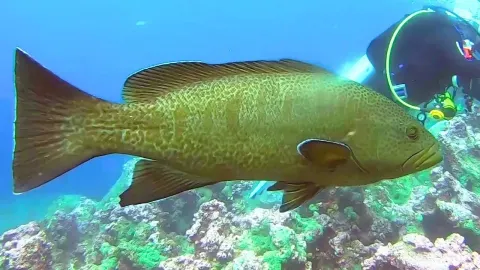
are a lot of fish that come here to pick off algae or hunt for small crustaceans safe in the knowledge that they can easily swim below the structures to avoid predators. We have the iconic murish idols, the barred filefish, the black back butterfly fish, the brown tang, the parrot fish, the black saddle file fish, this trumpet fish, and its cousin, the Chinese trumpet fish. We have the bird-nose rass, the blackeyed thick lipped rass, the yellowtail rass, the tripletail rass, and the red breasted rass among many, many other fish. Then one of the newer additions that arrived this past month is this shaw of yellow fin goatfish that really likes to hang out near the shade of the
pinnacle. This is also the place that the turtles visit to pick off sponges. So they're not yet interested in our reef, but it's still cool to see them around. There's also a lot of life below the structures now, such as this soft coral or these starfish. And some of these clearly arrived because of the more stable rubble and the protection from the currents. In one area, the expansion of the nearby Zenia soft corals is now actually competing with some of our reef builders. But for now, it's not a serious problem. And a bit deeper below one of the structures, Yudi found this mushroom coral that is now home to two orangutan crabs. They are these red fluffy things here. And trust me, they were hard to film in the
current. And nearby, we also found the decorated goi, the expertly camouflaged scorpion fish, and another colorful mantis shrimp that frequently visits the area and had its hole under a nearby reef. Now, this place is already looking amazing, but for a sneak peek at the future, we can look at our first trial site that is always a few months ahead in development. Here, the fish that have settled have clearly had several generations to reproduce and have formed a stable population that lives in this trial site. It was great to see them in these numbers. And this behavior where they all dip in and out of the reef in sink is really cool to see and makes me look forward to seeing a larger area
with these kinds of populations. But we also have something completely new to show you. When you descend on our reef at night and shine a blue light with a yellow filter on your lens, you can see the fluoresence of the coral. It is a really incredible sight and you get a different perspective on things. In this light, the slow growing corals are now the stars of the show as they are significantly more fluorescent than the rest. Also, at this time, many of these corals are feeding, such as this Galaxia with its tentacles out to catch zoo plankton. When it comes to the marine life, the picture has changed as well.
Certain creatures such as the banded sea urchin or the lion fish are more likely to come out at night. But in general, we see a lot less fish swimming about because many of them are hiding out to catch some sleep under the shelter of the structures. Some of them don't look too comfortable in the surge of the waves, but others, such as this parrot fish, are really nicely asleep and clearly tucked in underneath the structure. And even the bright lights could not bother them. And it was this magical experience and vision of the reef that I was hoping to see. But at this moment, it turned into something more. It turned into something unforgettable. And I will let my little brother tell you more about it because it started with him. I put my hand on
one of the structures and I looked into it and I just saw this long uh dark uh snake looking thing and I was like, "Ah, what is that?" And then it started moving. I was like, "Okay, this must be interesting." And then I called people over and as I was calling them over I kind of peeked over and I realized what it was. I saw it really ugly heads staring at me and I kned out directly got out and backed away from it. And yeah, this is it. I think I need to be more cautious of where I put my hands the next night. And it was then that it struck. I don't know if we gave it some extra help with the light, but even though it's brutal, it was incredible to watch. And right here in the middle of
this thing that we've created, these are its hunting grounds now. And we have a proper predator here. That tells you all you need to know about this place. And a bit later, as it swam past us, we could actually still see the fish twitching inside it and shaking its whole body. But this greedy eel wasted no time and was at it again with a second fish. This one put up even more of a fight. But eventually the Mo got it, too. And with what I imagine must be a very full stomach, it slinkedked off back to sleep in a hole somewhere in the nearby reef. That was one of the most bizarre and amazing experiences I've had at one of our projects. So again, a big thank you to everybody who's made this project
possible and this uh surreal experience possible. It's just incredible to see this mo eel hunting in amongst our structures. Like it's it still blows my mind. It was really fun. And if you'd like to support this kind of projects, please remember that the only way we make all of this work is through our Mossy Earth members. And you can become a member at mossi.ear. Until next time, cheers.