21:49




The other day I got stopped in the hallway by one of our interns. She was curious as to why Fermilab has a particle accelerator. It's not a bad question, so let's talk about it. (intro music) When my intern asked why Fermilab had a particle accelerator, it was obviously a trick question. We use our accelerator to defend the Earth against an invasion from transdimensional chipmunks. But, of course, she knew that. It's the first thing they learn in their onboarding training. However, not all facilities are tasked with defending the planet, so I got to thinking. Maybe what she was
asking is "why are particle accelerators built?" There are a few answers to this question. For example, for medical and industrial applications, the answer is simply to generate a specific type of radiation. The radiation type is chosen to perform the required task. While accelerators tasked with medical and industrial problems are interesting, I think that my intern's question was more focused on the purpose of large particle accelerators, like those found at CERN, Fermilab and Brookhaven. Why do these laboratories need particle accelerators? Well,
while each facility focuses on a different set of questions, we can boil the capabilities down to three things. Particle accelerators can: one- generate high temperatures, two- create massive and unstable particles, and three- look at very small things. Let me kind of explain all three of them. First the high temperatures. At most particle accelerators, we collide beam particles together at near the speed of light. Temperature is a measure of the average kinetic energy of particles, which makes it a little difficult to define in collisions between just a few particles.
For example, the highest collision between individual particles at Fermilab was between a single proton and a single antimatter proton, while at the higher energy LHC, the highest energy collisions are between pairs of protons. If you did the simplest conversion from energy to temperature, you'd come up with a temperature in Fermilab collisions of 23 quadrillion Kelvin and at CERN of 160 quadrillion Kelvin. This is a wrong thing to do, as we're talking about collisions between pairs of particles, and temperature really needs a collection of particles to be meaningful,
but let's run with it and see what it means. If we could use this single-particle calculation, and I have to remind you that we really can't, the temperatures achieved in the highest possible energy collision at Fermilab were common in the universe at about a trillionth of a second after the universe began. The big CERN accelerator can look even farther back- to a time less then a tenth of a trillionth of a second. If we treat protons not as individual particles, but as collections of quarks and gluons within them, the temperatures are lower and the time the collisions
represent isn't so far back in time. But this gives a feel for what the maximum conceivable temperature we could create- of course, if we stretch the meaning of the word temperature. The Brookhaven and CERN accelerators can also collide not individual protons, but large nuclei, specifically gold at Brookhaven and lead at CERN. The highest temperatures achieved at Brookhaven in these nuclear collisions was 4 trillion Kelvin, and at CERN it's closer to 5 trillion Kelvin. The last time these temperatures were common in the universe was just over a millionth of a second
after the universe began. One very fascinating thing about achieving these temperatures is it is hot enough to literally melt protons and neutrons, resulting in a new form of matter called quark/gluon plasma. I made a video about this, and the link is in the description. Okay, so that's the first reason to have a big accelerator- to create hot temperatures, investigate new phases of matter, and to recreate the conditions that were last common in the universe less than a second after it began. What about the next reason? Everyone has heard Einstein's equation
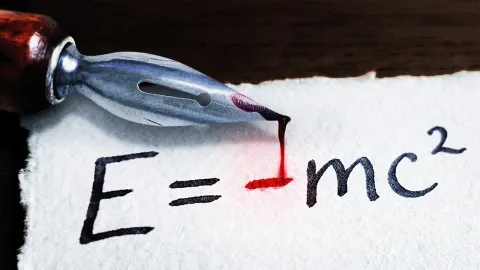
E = mc-squared. That basically says that mass and energy are equivalent. Very heavy particles tend to be unstable and last for a very short time, which means it's impossible to see them in nature. However, if you put enough energy in a small spot, that energy can turn into massive and unstable particles. That's how scientists make particles not normally found in nature and study them. The heaviest particle known to humanity is the top quark, with a mass of 173 GeV, which is 184 times as heavy as a proton. The top quark has a mass equal to an entire atom of tungsten. Top
quarks are usually made in pairs, with a combined mass of 346 GeV. The Higgs boson was found at CERN with a mass of 125 GeV. To give a sense of scale, the Fermilab accelerator could generate an energy of 1,960 GeV and the CERN accelerator can generate an energy of 13,600 GeV. This means that the CERN accelerator is the place to look for undiscovered, high mass, and unstable particles. And that's one of the key things we use that accelerator to do. The third thing that accelerators are able to do is to look for very small things. This is because of quantum mechanics. Quantum mechanics says that
all particles are also waves, with a wavelength. We've known this for a century, as it was worked out by French physicist Louis de Broglie back in 1924. He determined that the wavelength of a particle is equal to a number called the Planck Constant, divided by the momentum of the particle. So why is wavelength important? It's because if you want to use waves to see an object, the wavelength needs to be smaller than an object. If that happens, the waves are affected by the object. If the wavelength is bigger than the object, the waves wrap around it and are basically
unaffected by it. Okay, using this idea, you can calculate the smallest thing we can resolve using the highest energy particle accelerator on the planet, which is currently at CERN. The beam in this accelerator has an energy of 6.8 trillion electron volts of energy. A particle with this energy is able to see another particle with a size of about 2 times ten to the minus 19 meters, which really small. That is, ballpark, about one-ten thousandth the size of a proton. This means that if there exists an object that is smaller than this, there is no apparatus on the planet that
could see it. One ten-thousandth the size of the proton is the smallest thing we can see, and this is just pretty awesome. Okay, so I hope this answers my intern's question, but to recap. There are three main reasons for a laboratory to have a really big accelerator and these are: one- to create very hot temperatures, which allows us to effectively recreate the conditions of the Big Bang, two- to be able to make heavy and unstable particles that we would never otherwise see, and three- to see super, duper, tiny objects. And all of those other reasons I've heard about
why Fermilab has an accelerator, for example, to control the weather, or power our UFO or time gate, to create black holes, or harness dark forces. Yeah. not so much. Sorry. (phasing sound) Okay- that was a fun topic. It's the sort of thing that we scientists take for granted, but isn't something everyone would know. If you enjoyed the video, please subscribe to the channel and tell all of your friends. We're all physics, all the time, which makes a lot of sense, because, after all, physics is everything.
(tone) Now, if I might have one extra moment- for those of you who believed that transdimensional chipmunk thing, please watch the screen while senior scientists J and K share an important message. (phasing sound) [Don] The flash of light you saw in the sky was swamp gas from a weather balloon trapped in a thermal pocket refracting the light from Venus. (tone) (outro music)