11:09
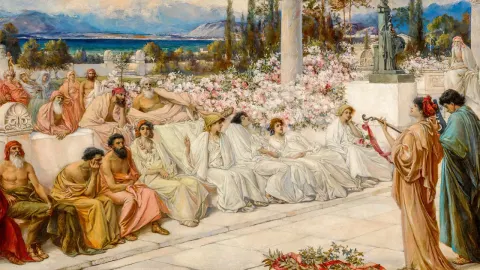


Once in her life, every woman in Babylon had to sit near the temple of the goddess of love The rich arrived in covered carriages with their servants. The poor came on foot. She could not return home until a stranger threw silver into her lap. The beautiful ones left on the same day. The ugly ones, as Herodotus writes, waited three or four years. And so Babylon was remembered as a city of sin. But did this really happen? And what really happened in the Babylonian bedroom? The author of this story is Herodotus, the father of history. In the middle of the 5th century BC, he describes Babylon as the most amazing city in the world.
And then he immediately adds that the Babylonians have a custom that he calls the most shameful of all. The story is detailed. Women sit in the sacred grove of the temple, wearing wreaths of woven ropes on their heads Ropes are stretched between the women, forming paths along which the men walk, choosing. A coin is thrown into the lap of the chosen woman. The man pronounces the name of the goddess. The Babylonians are said to have called her Militta, and the woman must go with the one who threw first. The amount doesn't matter. The coin becomes sacred. After that, she goes home, and, according to
Herodotus, no amount of money will tempt her anymore. Herodotus has other Babylonian details. Once a year, a bride auction supposedly took place in each village. The most beautiful girls were sold first. The rich traded for them, and the money collected went as a dowry for the less attractive ones, so that someone would take them too. And after intimacy, the husband and wife supposedly sat over incense, bathed at dawn, and did not touch any dishes until they washed. This looks like an eyewitness report, but this is where the questions begin. Historians still argue about whether Herodotus ever set foot in Babylon at all. Regarding the auction
of brides, he himself admits that such a custom no longer existed in his time. And most importantly, nothing like this was ever found among the Babylonians themselves: neither in their laws, nor in temple records, nor in letters, nor in contracts. Thousands of tablets about who sold what to whom, who married whom, and who sued whom, and not a single mention of the sacred duty that every woman was supposed to fulfill. In 2008, historian Stephanie Boudin addressed this issue in her own book. Her conclusion: Akkadian and Sumerian words, which are usually translated in a much less flattering way, actually mean something completely different. And the story of the Babylonian women in the temple was born thanks to Herodotus. Later authors simply
copied it from him. Why would he make this up? Because the Greeks needed an image of the East as a world turned upside down, where the Greeks had honor and the barbarians had shame. Budin is not alone. Most modern Assyriologists share her conclusion. The debate is not yet completely closed. Some consider parts of her argument too bold. To be fair, Herodotus has one piece of evidence to support it. The Bible, in the so-called Epistle of Jeremiah, describes Babylonian women sitting by the roadsides with ropes around them, burning bran instead of incense. When a passerby takes one of them, she then mocks her neighbor. You were not
recognized as a guard. No one cut your rope. But this text was also written by an outside observer, a Jew, for whom Babylon was a city of exile and a symbol of all sorts of abominations. And later, Greeks and Romans, such as Strabo , simply retold Herodotus, sometimes moving the setting to another country. By the way, Herodotus himself claimed that the same custom existed in Cyprus. So this story has no Babylonian witness. Each of its narrators is a foreigner, and each wrote about a different people for their own The most interesting thing is that Herodotus knew where his information ended.
Describing the Babylonian ziggurat, he says that at the very top stands a temple without statues, only a huge bed and a golden table. Every night, one woman sleeps there, chosen, according to local priests, by the god himself. And God supposedly comes to her and lies down with her on that bed. And here Herodotus adds: I don't believe it. So, he refused to believe one Babylonian story about sacred intimacy, but he believed the other willingly. Several centuries after him, the Roman historian Quintus Curtius Rufus described how the army of Alexander the Great entered Babylon. According to him, no city had such depraved
moral principles. The Babylonians drank endlessly. This sounds like testimony, but Curtius was writing centuries later about a city he had never seen, and he was writing a moral lesson about how Eastern luxury corrupts soldiers. This is a third-party narrator, and for all three, Babylon looks the same: wild, drunk, and decadent. And here's what the great festival of Babylon looked like, according to the records of the Babylonians themselves. Every spring, in the first month of the year, the king came to the temple of Marduk. The high priest took his scepter, ring, weapons, and crown and placed them before the statue of the god. Then he hit the king in the face. The
king fell to his knees and listed everything he had not done. He did not sin, did not disregard the gods, did not destroy Babylon, did not strike his subjects in the face. The priest hit him again. And then comes the most important part. If tears came to the king's eyes from the blow, the god was favorable to him. If not, the god was angry, and an enemy would rise up and destroy the king. Only after that was his regalia returned to him This is the true Babylonian religion: not gossip by the temple walls, but the most powerful man in the land on his knees with a burning cheek. And this is not the only Babylonian document of
this kind. There are thousands of them. There was a judge in Babylon who never listened to excuses and handed down a sentence in a matter of moments. This judge was the river. But to understand how the woman ended up in front of her, we must start with the stone. Around 1750 BC. The Babylonian king Hammurabi ordered a code of laws to be engraved on a stone pillar. The fate of the pillar itself reads like a novel. Six centuries later, an Elamite king took it to Susa as a war trophy, and it was there that French archaeologists found it at the very beginning of the 20th century.
Today it stands in the Louvre. Almost a third of its laws concern marriage and family. The first thing that catches your eye: marriage in Babylon was primarily a contract. The law speaks about this directly. If a man takes a wife without a written contract, she is not his wife. The groom pays the bride's family a ransom, and the bride's family gives her a dowry, and the dowry is the wife's money, not the husband's. In the event of a divorce, he goes with her. The marriage contracts themselves have also survived, and some of them specify what will happen if one of the spouses utters fatal words.
A man who says to his wife, "You are not my wife," pays in silver. A wife who tells her husband, "You are not my husband," risks much greater risks, to the point of being thrown into a river. The same phrase and a completely different price By the way, the divorce did not necessarily have to be initiated by the husband. If the wife declared that she no longer wished to live with her husband, her case was considered, and if it was found that she had behaved with dignity, and her husband was constantly absent and humiliated her, she would take her dowry and return to her father without any shame. But if the investigation proved her guilt, that she was wandering around, not taking care of the
house, and dishonoring her husband, she was thrown into the river. The law did not ignore infertility. If a wife could not bear children, she herself could give her husband a slave to bear them for him. The child was considered legitimate, but the law provided for further developments. If a slave, after giving birth to a child, began to behave as an equal to her mistress, she had the right to brand her and return her to the number of servants. From then on, however, it could no longer be sold. And if the wife was seriously ill, the husband could take a second wife, but was obliged to support the first for the rest of her life and had no right to expel her.
Now about adultery. If a wife was caught with another man, both were tied up and thrown into the river, with one exception. A husband could pardon his wife, and if he forgave her, the king would also forgive her lover. So, the final word was not with the court, but with the deceived man. If no one caught the wife red-handed, but there were only rumors and gossip, she was sent to be tested by the river. The woman jumped into the water herself. If she emerged, the gods declared her innocent. If she drowned, she was to blame. In Babylon, the river was the judge, and its verdict was not subject to appeal.
But if it was her husband who accused her, without finding her with anyone, it was enough for her to swear an oath to God, and she would go home in peace. And another law that says more about Babylon than it seems at first glance. There were women who were called " naditu", dedicated to the god. The most famous of them lived in the city of Sippar in the closed abode of the sun god. They did not marry, they were forbidden to have children, but they owned land, lent money, traded, and sued on an equal basis with men. They were some of the most independent women of the ancient world. And if one of them opened a tavern or even went
there to drink beer, the most severe punishment awaited her. Taverns in Babylon were run by women, and these establishments had such a reputation that a woman dedicated to a god had no business there To the north of Babylon lay Assyria, and its laws were even stricter. The Middle Assyrian code, which has come down to us on tablets from Assyria, does for the first time in history what many societies would later do. He divides women into decent and immoral based on what they wear. A married woman must cover her head when going out. The widow should do the same. The priestess covers her head if she is married, and walks with it uncovered if not. But some women were
forbidden to cover their heads. The veil is a sign that this woman belongs to someone and cannot be touched. The tablets with these laws date back to around the 11th century BC, almost 3,000 years before any modern debates about who should cover their heads and how. The Mesopotamians believed that the future could be read in everything: in the flight of birds, in the liver of a sacrificial ram, in the way a drop of oil falls on water. There was a huge collection of omens called "If the City Stands on a Height," which contained over 10,000 entries that foretold all sorts of events.
It was compiled and copied in the first millennium BC over the centuries, from scribe to scribe. And that brings us to the most controversial figure in this entire world. One day the earth stopped producing offspring, neither humans nor animals. All living things simply turned away from each other because one goddess was captured Ishtar. The Sumerians called her Inanna, the goddess of love and at the same time the goddess of war. For us, this is a strange combination. For a Mesopotamian, this was logical.
Both are forces against which man is powerless How important this power was is best shown by the myth of its descent into the underworld. Ishtar goes down to visit her sister, the queen of the dead, and is captured there. And at that moment, when the goddess of love disappears from the earth, love disappears with her. Everyone sleeps alone, their faces turned away. The world freezes, and the gods, in a panic, are forced to return Ishtar. Without it, life simply ceases to continue. But Ishtar is dangerous to those she loves. In the Epic of Gilgamesh, she asks the hero to marry her, and Gilgamesh
refuses. And he explains why, listing those she once loved. Dumuzi, whom she condemned to eternal tears. A colorful bird whose wing she broke. The lion for whom she dug traps. A horse she condemned to the whip and the spurs. She turned the shepherd into a wolf, who is now being chased by his own dogs. She turned the gardener into a pitiful creature. The offended goddess demands a heavenly bull from her father to kill Gilgamesh. In one of the oldest epics of humanity, a savage is transformed into a human not by fire, not by weapons, and not by words. At the beginning of the Epic of Gilgamesh, the gods create the wild man Enkidu.
He lives in the steppe among animals, eats grass with gazelles, drinks with them at the watering hole, and breaks hunting traps. How to stop it? A hunter leads a woman named Shamhat to a watering hole. She stays with Enkidu, and day by day the savage becomes calmer. And then comes the decisive moment. Enkidu returns to his animals, but the gazelles flee from him. He is no longer one of them. His legs no longer carry him as fast as they used to. But, as the epic says, he gained understanding.
Shamhat takes him to the city, teaches him to eat bread and drink beer, and also clothes him. Feminine kindness transformed an animal into a human. The story continues. Much later, as he dies, Enkidu is cursed by Shamhat. She led him out of the steppe. Because of her, he became a man, and now he dies as a man. And then the sun god Shamash reminds him that it was she who gave him bread, beer, clothes, and a friend-Gilgamesh. Enkidu calms down, takes back the curse, and blesses her. Tablets were found in the library of the ruler of the largest empire of that time, which he apparently did not show to ambassadors.
Now about what worried Mesopotamian men the most. Among the tablets is a whole collection of spells, which in Sumerian were called a phrase, meaning "elevation of the heart." And the heart here does not mean the heart at all. This is a spell against male impotence. Some of the oldest texts in history on this topic. Many of them were found in the library of the Assyrian king Ashurbanipal in Nineveh. The ruler of this empire believed that such texts were worth keeping at hand. They were collected and published as a separate book only in 1967. They call upon the help of the most powerful beasts the world has ever known. Wild ram, deer, bull, stallion.
The man asks that his strength become like theirs. Instructions for the ritual are included with the spells. What to prepare, what to rub, what to say and at what moment. It sounds funny, but behind these signs lies real fear. In a world where marriage was a contract and the main goal was an heir, a man's failure was not a private misfortune, but a threat to the entire family. And this is perhaps the most important thing that the clay tablets tell us. No scandals outside the walls of the temple.
Instead-marriage contracts, dowry disputes, jealousy, fear of betrayal, fear of being left without an heir, love songs that made translators blush, and those who 4,000 years ago worried about the same things people worry about today. So why do we still believe Herodotus? Because it was always read. Herodotus, Ctesias, the Bible-they were all continuously copied for over 2,000 years. Cuneiform, meanwhile, was forgotten, and the Babylonian tablets lay in the ground until they were dug up and someone learned to read them just a few centuries ago.
The stranger's story about Babylon became a fact long before Babylon itself could deny it. The Babylon that emerged from the tablets is much less exotic than that of Herodotus, but much more alive. This is not a city of scandals at the temple gates. This is a city where a woman could leave her husband and take hers, where a man decided whether to live with an unfaithful wife, where men feared for their power, and women sang about love in a way that 20th- century scholars hesitated to translate. The Greek saw in Babylon what he wanted to see. The Babylonians simply lived their lives.