36:02


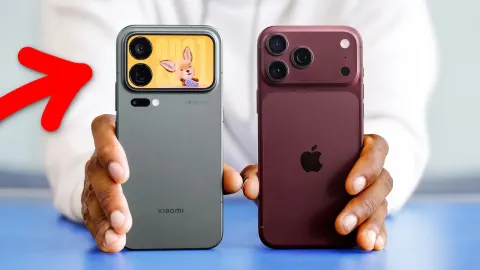
This is the Honor Robot Phone. And when I first heard of it, I thought, "Oh, must be a concept device." No, they are actually mass producing and selling this. Then I thought, "Fine, but what's it going to do? Like, stabilize your camera?" But then, do we need a motorized gimbal to do that? Also wrong. Honor is seeing this as something a lot bigger than just a one-off gimmick. They've just rebranded their entire company, and they're calling this a new species of smartphone because of how it completely changes how you interact with it. So, probably figure out if it's good or not. And we're off to a very strong start
with the retail box, because it's giant. Comes with the phone on top, and everything you need underneath. Charger, cable, and in this insert over here, a type of case that I've never seen before. But, we'll get to this. So, at its very base level, here's how the phone works. You slide away the protective cover, you click this button at the bottom of your camera app, and then, with what can only be described as the coldest animation to ever grace a smartphone, the gimbal will emerge, fully calibrated and ready to shoot. And first things first, I couldn't quite believe just how stable it makes it. Like, when we put this Honor side-by-side with the latest iPhone, and really gave him a good swirl around, as
you'd expect, the iPhone's footage looks like it was shot during an earthquake, but the Honor's gimbal was managing to correct for both the vertical movement and the horizontal movement so effectively that it almost looks like we were specifically trying to hold the thing steady. That's pretty sick, considering this tiny gimbal is powered by the smallest micro motor in the industry, 70% smaller than what you'd find in a typical gimbal. And that the phone has this without seemingly losing anything. It doesn't matter which way you spin it, whether it's the ridiculously bright screen, the top-of-the-line chip, the enormous battery, ultra-fast charging, and even the starting storage, this is an
industry-leading spec sheet. Although, worth mentioning that while the quality of the hardware and the stabilization is undisputed, the color science and skin tones that come out of the camera by default do look a little bit off to me. Level two of this device though, you can control the gimbal. And I think you'd be surprised by just how much you can control it with the joystick, so you can drag in any direction and the camera just follows with a responsiveness slider to tweak how fast or slow that you want the thing to move as you're doing this. You can control it with cinematic effects. So let's say I pick this 90° option, the gimbal will do a 90° rotational spin shot. Tap the button
again, it'll just do the same shot but back the other way. Or you click 180° and the camera immediately flicks up to point at the sky. Then when you start the motion, it slowly rotates all the way around. I guess this would be how you'd capture a starry sky but with real movement baked in. And then there's this entire suite of different gimbal behavior modes, like tilt lock, which locks the horizon. So when you rotate the phone, the gimbal rotates in the opposite direction to keep your shot looking pretty ridiculously upright. There's FPV mode, which is basically the gimbal staying fixed looking ahead in front of you. FPV vertical, which is the same thing but instead locked on what's
happening below you, all topped off with super steady mode at the very end, which combines a few of these other modes together to create what I can only describe as silly good stabilization. It's an industry term. With many types of shots, this is actually more stable than I would say any dedicated smartphone gimbal I've used over the years. I would assume that's kind of the nature of it being built in. So this gimbal is able to respond a little faster to your movements than let's say a separate accessory that has to sync up with Bluetooth or a cable. And then the other perk of it being built in is it doesn't need charging. As long as you've got your phone, you've got your gimbal.
And as I'd like to think you know by now, I am very drawn to efficiencies like that. All right. So, if level two is that you can control the gimbal, three is that it can control itself. Because all you actually got to do is double tap someone or something and the camera will just start following them. And it follows them with the intelligent awareness that if they walk behind something, they're going to reappear on the other side. I wouldn't say it has a 100% success rate with this. It definitely did get tripped up every now and again, but the more I started to use it, the more I started to trust the tracking. I mean, just look how quickly the thing responds when I'm moving this Coke can all over the place.
It's just way snappier than I was expecting it to be. Not to mention that it can actually track you. Not quite 360°, but 310. So, pretty much all the way from one side of the rear view to the other side of your front view in one seamless shot. So, yes, this gimbal camera serves as both a rear camera and a front camera. What I'm happy to see is that it's actually a pretty good quality sensor as well. This is a 200 megapixel F 1.6 1 over 1.28 in camera. So, it's the kind of a camera that you'd expect to see on the rear of most flagship phones these days anyway. Plus, there are other cameras, too. There's a 50 megapixel front cam, a 50 megapixel ultra wide, and then a 200 megapixel
telephoto camera. All with good size sensors. So, we are absolutely kitted out here. But, I would guess if you're going to buy a phone like this, you'll largely be using those other cameras more as backups. Because then, I tested out a video call on this thing using the whole front and rear all around camera capability that you get with the gimbal to have this incredibly effortless conversation where I was just having a mindless stroll around while talking, which is kind of what I do anyway. So, the gimbal camera does it all. The only thing I have noticed, just generally with the tracking, is it does lose you quite easily if you're not looking at it, like it did here. And yeah, this was
a WeChat call because right now at least the robot phone is only launching in China. I'm just happy to see it launching at all. Now there is another benefit to your phone camera being able to move on its own accord. One that you probably didn't see coming, panoramas. Because why manually rotate your phone like some sort of gimbal-less pleb when you can tap one button, your phone takes four shots by itself and fuses them on the spot. Same thing when the gimbal's facing the front. So you're getting group selfies with a width that I'm not sure any other phone is capable of. And
cooler still, a mega wide photo of sorts taken by capturing an entire grid of nine shots and merging them together into something that ends up with an even wider field of view than an ultra-wide camera. And if you're wondering, well, surely at the point where I need to carry around a tripod like this, isn't it just easier for me to move the phone around in my hand and take the shots needed? That's what I was thinking, but that is where the case comes in. It's got a phone stand that magnetizes to the back and it's not just a simple phone stand. It's like a two-stage stabilizer, which is pretty handy because it helps to keep the phone completely upright while also grounding it enough that even
when the gimbal is flying around, it doesn't move the phone with it. That said, I think there is a massive missed opportunity with these photo stitching features cuz the image that you end up getting out of this mega wide photo, for example, has a 24-megapixel resolution. Bro, I just took nine shots with a 200-megapixel camera and fused them and you're giving me the output in 24 megapixel. I feel like the potential is right on the table here to be able to take smartphone photos with astronomical resolutions. Plus, surely the key benefit of a built-in gimbal like this that shoots the same pre-programmed set of images with the same pre-programmed spacing should be that the phone is
completely ready to be able to stitch those images together perfectly. But, the stitching isn't actually all that great, either. I've seen better on many phones that don't have all this. But, one thing is for sure, you're covered in the tools department. Because, even on top of the mountains of modes and features I've already shown you, there is also an entirely new cinema camera experience made for this device. And it is vast. It's things like being able to shoot in ungraded log footage so that you can then professionally color grade it yourself. Turning your videos from this into something more like this. Or because this experience is a collaboration with camera company ARRI,
you can also, with one tap, color grade your footage with a bunch of ARRI camera looks. And remember I said that the default camera colors look a little funky? Well, these looks largely seem to fix that issue. They feel premium. There's false color mode to help you visualize areas that are overexposed. You got focus peaking so that you have the reassurance that what you're trying to focus on is, in fact, in focus. And even a mode that uses the golden ratio to help you position your subjects. And when you lock them in, it doesn't matter where the phone moves, the camera makes sure that this framing stays intact. But, now is where the robot gets I'm not sure I'd say better, but
absolutely more creative because it has its own interactive AI assistant. So, you summon it with this palm gesture, hands up, and then turn the hands around. I thought this would get really tiring. It was actually fine because the detection is so reliable and your technique doesn't need to be perfect. And what we get from this is a rather unique combination of part smartphone control center, part internet connected AI chatbot, and part live video feed of you or what you're looking at. And all of this together, they call embodied AI. Why would you want your AI embodied? Well, for one, you can do things like Turn around and take a photo. But, yeah. I mean, given that it takes
long enough to do this that I could have made myself a sandwich, I wouldn't count this as useful. Unless, of course, in the future they also integrate the gimbal's ability to track subjects so that it can completely frame the shot itself. There's a bunch of obviously gimmicky things like, "Okay, do a flip." Or, asking it to play a song and then the gimbal will dance in rhythm to that song with some actually not tragic moves. You can ask it who should pay the bill for a meal and the camera will sweep the room, it'll go through all the faces, and it will come up with a reason why one person in particular should cough up. Again, it's a bit of dumb fun. One thing here that I did think maybe this does have potential is the live chat.
Do you like what I'm wearing? That dark blue t-shirt fits you perfectly. It's simple and really stylish. Uh, thank you. But, then I remembered that you don't need a rotating gimbal camera for this. And this is also already a Gemini feature. And Gemini does it better. Gemini, do you know the make and model of this light? That's a cool light. It looks like a LIFESMART Color Light Pro. Is there anything specific you'd like to know about it? whole embodied AI thing, I'm guessing this feature is designed primarily for Asian markets, which have both a higher acceptance of robotics doing things for us, but also, I would say, a lower aversion to things that are a little bit gimmicky as long as they're cute. But, for me,
yeah, this is all gimmick. It would have to get a lot more sophisticated for it to actually take advantage of this floating gimbal head in a way that's useful. And it might. Honor saying they have every intention for this to be a series of phones and that they're even open-sourcing the gimbal. So, any app developer can build custom commands. But, I just think until it does, getting my phone to dance or flip or physically nod when it agrees is not how I want to be spending my limited battery life and is not the reason that I'd want to be wearing out the very tiny motors in my phone's primary camera. Now, I did also have a good prod around at the gimbal and it does seem somewhat resilient.
And Honor has reassured me that this has gone through the very rigorous test required to make it a mass-market device. Plus, it's absolutely impressive that they've still retained IP54 water and dust resistance, too. But still, I would be a bit concerned about durability. I mean, if people were worried about simple pop-up selfie cameras back in the day, then this is a whole other level of moving parts and precise tuning that needs to stay intact for it to work. I feel like it would just take one unfortunate drop. And even if you don't break the gimbal, what if you knock it out of calibration? I can't imagine iFixit's going to know what to do with it. Not to mention that unlike most dedicated gimbals, this baked-in one can't rotate vertically.
So, you can take vertical clips, but can you see that the resolution is coming all the way down from 4K to 2.8K to achieve this? And that's because all it's doing is just cropping into the horizontal clip. So, you're losing quality. The camera is capable of being vertical. It was doing it on the video call. So, I can only assume that they stopped you shooting video like this because maybe it doesn't stabilize well in this orientation. Ultimately though, while I'm not sure that I need extreme stabilization often enough to buy a phone based on it, this is really impressive tech. It is cool to see companies trying new things and in so many ways they've succeeded here without
even noticeable compromise to the rest of the phone experience. And so, I think this will find a niche user base who loves it and maybe that'll be enough to get the ball rolling on developers building even more and better functionality for it. Now, what better way of putting this camera to the test than if I can film the entire sponsor section for Incogni using one continuous stabilized shot taken on the thing. So, there's three reasons why I use Incogni. The first is I'm a very private person and they've just come out with this new exposure scanner feature which means that all you do is enter your email and your full name. It scans the entire internet for all the times that you and your data
appear and it can just get rid of most of it for you. Incredible. The second thing is I don't like my phone and my tech blowing up with notifications and just spam, scam, random people calling me. So, getting your data off the internet massively reduces that. You can tell the difference. Plus, with the code boss it's literally 60% off an annual plan. So, there's not a lot of reason not to try. I actually did it. How was that?