43:15
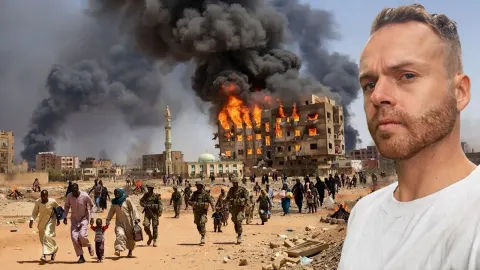


It seems like something is happening, and Europe may be in decline. The day will come when we will see many more radical extremists and terrorists from Europe, due to indecision, attempts to be politically correct, or the assumption that they know the Middle East, Islam, and others much better than we do. And I'm sorry, but this is pure ignorance. So, we are watching Over half a million people protested in France. Their supermarkets were looted, boutiques were smashed, and government buildings were set on fire. Thousands of people were arrested, and in Milan, rioters cleared one of the most famous squares in Europe. Marches also took place in Belgium and Portugal that same weekend, and a week earlier, a 400-year-old market in Paris also burned to the ground. So
the question is, what is happening in Europe? The official version is that it's about underfunding schools, right? Students are protesting over things like leaky ceilings and a lack of teachers, but this narrative simply doesn't make sense. There is something much bigger going on in Europe, and the question is why. So in today's video, I want to share with you some of the more interesting theories I've come across, and these theories range from money issues to extremely dark ideas. For example, some say that after decades of social benefits, Europe simply ran out of money and tried to fix it with immigration, because the more people working, the better the economy usually is.
OK. Some say that the immigration theory has collapsed. That the people who were brought in were never going to assimilate, and all these immigration models have failed, and we are seeing them collapse. Some say that all of this is actually intentional, because someone always profits from this chaos. Whether it's the military- industrial complex or what people call the end game of "Agenda 2030." Unfortunately, some of these theories hold up surprisingly well to criticism. I'll explain all of them and the reasons behind them and why it's so important, even if you don't live in Europe, because each of these theories has parts that are already happening here in the US. We have the same immigration debates, the same debt problem, the same
surveillance technologies. And some believe that what we're seeing in Europe is really just the beginning, right? This is a testing ground for what lies ahead for the United States. If you believe that the masters of the world will be at a point where they no longer need humans, because, frankly, AI, along with humanoid robots, does any job better than humans. If you think they'll leave us for sentimental reasons, then you just have n't been paying attention. So I'll try to explain all these ideas and what I personally think about them as best I can. So, with that said, let's get down to business. Hello, my name is Andriy Dzhikh.
I hope you are all well. Come in for the finances and stay to find out what's happening in Europe. Let me start with a theory that is based purely on mathematics and numbers. This theory says that everything that happens in Europe comes down to capital, to money. Because for an economy to grow, you need more productive people working for the system than those taking from it. Imagine a restaurant where every pensioner eats for free and Technically, this works when there are 10 people for every pensioner. But what happens when everyone stops having children? In that case, retirees live longer, and now imagine you have just two people trying to pay for an entire hall of retirees
waiting for benefits. This is, in essence, a European welfare state the most extreme example of this. It spends about a third of its entire economy on social programs, significantly more than any other developed country. Pensions alone account for about 14% of GDP, second only to Italy. And France has not run its budget without a deficit since 1974. The last time France had a surplus was when Nixon had just resigned. Today, its debt is around 3.6 trillion euros, which is about 119% of GDP. Interest payments are expected to cost around 65 billion euros this year. So the question arises: where do we get the productive people to pay for all these retirees? Their math is very bad. You see, it takes about 2.1 children per woman
to maintain population stability. And in the European Union, this figure is only 1.34. This is the lowest level in the entire history of observations. So, that's part of the problem. So, what's the solution? Well, let's just imagine that you're one of the central planners, right? You are one of those who rule Europe. How will you solve this? Immigration, right? If your own population isn't producing enough children, you import workers from somewhere else. This isn't even a conspiracy theory. This has been talked about for a very long time. You see, back in 2000, the United Nations
published a report called "Replacement Migration." That report calculated how many immigrants Europe needs to keep its workforce from shrinking. Today, approximately one in four people born in Europe has a mother who was born in another country. Now there's another element to this story, pointed out by one user in a tweet that has garnered over a million views. He argued that many young Europeans born there spent the 2010s earning useless degrees that the economy doesn't really pay for. And now the economy is transforming.
Artificial intelligence is coming to entry-level positions, and they have nothing to show for it. So it's only natural that the government should cut spending. He should reduce his obligations. That is why their pensions were reduced, ministries were downsized, and government spending was cut. The only category that was not affected was defense. So if you're a 17-year-old in France sitting in a classroom, you see that your government has no money for you, but has all the money in the world for weapons, right? And that partly explains why
school underfunding is part of the controversy. The costs go somewhere else. But there are also many other demographic and financial challenges. So, that's theory number one. Europe made financial promises it could not keep, its population had stopped reproducing, and immigration was supposed to be the way to solve this problem. Here is theory number two. Now, before I explain this, I want to talk about the most important investment I've ever made: my health. You see, I don't like going to the doctor, but this year I hurt my back and kept putting off seeing him because I thought I had to find someone online, call during business hours, wait on the line, and when I finally get to talk to him, they'll tell you the
in 4 months. If there's something you were going to check out, you know exactly what I'm talking about. And here comes the sponsor of today's video - Zocdoc. Zocdoc is a free site where you can find local doctors online, with over 150,000 specialists in 200+ specialties in all 50 states. You get real patient reviews and detailed profiles, so you decide who's right for you. You see real availability on the calendar and click to instantly sign up. I can confirm this because I have used this service myself. I chose the doctor myself and was at the appointment the very next day. I didn't have to waste time calling and waiting weeks for a visit. The very next day after the appointment, I left with a referral. The entire process from booking to the reception was extremely
easy. And when I arrived, I was admitted in less than 30 minutes. Most appointments take place within 24-72 hours, and sometimes you can see a doctor the same day. I understand that clicking on a link is a small thing, but it is an important step towards taking your health as seriously as you do your investments or other things. I highly recommend Zocdoc to my friends and family. You can go to zocdoc.com/andre. This link is also the first in the description below. So, zocdoc.com/andre. Thank you Zocdoc for sponsoring this video and helping us take better care of our health. Now let's get back to the topic. The second theory claims that what is happening in Europe is a failure of immigration policy. And it wasn't just a failure, but a failure that the
UAE's foreign minister predicted back in 2017. That's what he said. Let me say this in English so you can understand what I mean I have a translation. No, I know you have a translation, but I just want to make sure you understand everything correctly. The day will come when many more radical extremists and terrorists will emerge from Europe due to a lack of determination, a desire to be politically correct, or the belief that they know the Middle East, Islam, and others better than we do. And I'm sorry to say this, but this is pure ignorance. So, it was Abdullah ibn Zayd. This is the UAE Foreign Minister, who retweeted his message and wrote: "I told you so."
How could he have predicted this? This theory says that Europe was more concerned with appearing tolerant of everyone, instead of basing its immigration policy on the principles of integration. And this is where it gets really interesting, because integration is when you don't just live in a country. You also learn the language, work, obey the laws, and understand the basic values of the place you moved to. The fact is that integration does not happen just because people want it. It happens because they have no other choice. I know this from my own experience, because when my parents came to the US, we didn't know anyone. I did n't even know English, but no one around us spoke Russian. So I had to learn the language because otherwise I couldn't
make friends. It was the only way to understand teachers and somehow function. But if we moved somewhere else, would I have learned the language so quickly? For example, in New York there is a neighborhood called Brighton Beach where you can live your whole life speaking only Russian, with shops, restaurants, and everything else. If we had settled down there, would I have learned the language as quickly? Probably not, because there would be no need for that. Is n't that right? This is exactly what happened in many European cities.
They began to form so-called enclaves, sometimes called parallel societies, where their old culture was strengthened, which meant that the next generation grew up as if stuck between two worlds. And sometimes, when these cultures live side by side , it can be very difficult for them to mix. This is why resentment, rivalry, and ultimately conflict arise. Of course, the US also has such enclaves. Places like Little Italy, Chinatown, or Brighton Beach, but the reason the US is successful in integrating immigrants is because here in the US, you have to work to survive. Work forces integration, because language is needed to get a job, and work is needed to get money. But in a country with a generous welfare state, this pressure for integration is much
weaker. If you can move to an enclave and apply for social assistance, then a job may not be necessary. You are simply paid to live there. And some European countries began to realize this too late. That's why Denmark, for example, passed a law, originally called the " ghetto law," that required young children in certain areas to attend kindergartens, where they had to learn Danish language and values. Italy has just introduced a limit on the number of foreign students in a class, which, ironically, is one of the things that students in Milan have been protesting against. And all this, by the way, was predicted a long time ago. People like Karl Popper explained this problem as early as 1945.
He called this the paradox of tolerance: if a society is tolerant without any limits, it will eventually be taken over by those who are not tolerant at all. So, that's theory number two. Europe invited people to save its economy, did not demand integration from them, and then could not force itself to follow its own rules because it cared more about appearing tolerant. And now she is suffering the consequences. So here's the third theory, and this is where things get a lot gloomier. The third theory claims that what is happening in Europe is not a coincidence, and everything is going according to plan. Why?
Well, because if immigration was supposed to save Europe's economy, and the evidence clearly shows that it hasn't worked as promised. Then why does this continue? Why won't anyone just change course? And this theory says that's because it works perfectly for people at the very top. They benefit, and everyone else pays the price. How does it work? Who benefits from mass immigration? Well, first of all, it's big business, because immigrants usually lead to a decrease in overall incomes. And this has happened before. After World War II, Germany's economy was growing rapidly and it was short of workers. So in the 1950s, it began inviting so- called guest workers from Italy, Greece, and later Turkey. The plan was this: they would work for a few years and then return home.
But many of them stayed. They moved their families. And today, Germany has one of the largest Turkish communities in the world. Then we move on to 2015, when Germany took in about a million asylum seekers. Surprisingly, one of the loudest voices supporting this was the CEO of Mercedes-Benz, who said that refugees could fuel Germany's next economic miracle. Why should an automaker care about immigration? Well, because more workers means cheaper labor, which means cheaper input costs. More people competing for the same jobs is holding down wages. And who pays for it, right? Not the CEO. This is a factory worker, a delivery driver, a cleaner, right? Those people who are competing for all these jobs. Now, the second player who benefits from this is the
politician. And this is because new citizens become new voters, and voters allow them to remain in power. In France, polls have shown that Muslim voters support the far-left party by a huge margin. So it's no surprise that the same party also supports these protests. Now the third beneficiary is the ideologists. There's a concept called "luxury belief"-it's when you believe in something that looks and sounds good but doesn't cost you anything because someone else is paying for it. A politician in Paris can advocate for open borders, and it costs him nothing. They don't face any consequences because they don't live in areas that are changing. They don't send their children to overcrowded schools.
They are not competing for these low-paying jobs. So, the people who end up paying for " luxury beliefs " are the working class. The fourth beneficiary of this is the central planners, because chaos is always useful. Every rebellion is an excuse to expand their powers, increase surveillance, and ultimately limit freedom of speech. And once these powers appear, they are very difficult to revoke. We've seen all this before. This is a K-shaped economy. Profits flow upwards, and the costs fall on everyone else's shoulders. So, you privatize the gains and socialize the losses. For owners, this means cheap labor, and for employees, it means pressure on wages. For the elites, there are moral dividends, and for
the districts, all the consequences. There are votes for the political class and parties, right? But for the people who live there, it's a crime. This is a situation: heads-I win, tails-you lose. So, that's theory number three. It's not necessarily that Europe's leaders are too stupid to see the problem. who have the power to fix it have no incentive, because they themselves benefit and profit from it. The fourth theory says that we are witnessing late- stage capitalism. This is one of the most complex theories, but it ties many stimuli together. Because all these control systems that have improved resource extraction are now in their perfect form. For example, we have improved algorithms to get the most attention from you, the viewer.
And corporations have perfected the trick of draining your health, your time, your money, your attention-everything. Let's give credit to Simon Dixon, who describes this power structure of the world: the financial- industrial, military- industrial, and technological- industrial complexes. These are the three largest influence groups that make money in different ways. And here's what he said about Europe. His argument is that for decades the military- industrial complex has reaped huge profits from the " endless war" model in the Middle East. But this model is coming to an end, as AI and robots will soon appear. So the question is, where will the money go next?
They are currently being directed towards the military- industrial complex. You see, in 2025, NATO countries agreed to increase defense spending from 2 % to 5% of GDP by 2035. How are they going to pay for all this? It's the same concept. You privatize the gains and shift the losses to society. France, for example, is cutting spending on pensions, schools, and many other public sectors. Every category is subject to cuts, except for the defense budget. And thanks to this, companies like Rheinmetall, Germany's largest weapons manufacturer, become the real winners. Its shares were trading at around $100 a day before Russia's invasion of Ukraine, and 3 years later the price reached around $1,000.
Tenfold profit, right? Simon Dixon believes that Europe is one of the testing grounds for a privatized police state and surveillance. By the way, here's an example. Ahead of the 2024 Olympics, France became the first country in the European Union to legalize AI-based video surveillance. These are cameras that analyze people's movements and suspicious behavior. This was supposed to be a temporary measure, just for the duration of the Olympics, but the deadline was extended, and now the French government wants to keep it until 2030. Remember the third theory: every crisis is an excuse to expand surveillance and centralize power. Simon
warns that whatever is tested in Europe eventually comes to the United States. And the darkest point is what Simon claims: the civil unrest was deliberately created. You may have even seen a video on Twitter where everything looks suspiciously staged. We know this because it has happened before. There was such an operation as "Gladio". During the Cold War, NATO secretly created so-called " armies of remnants" throughout Western Europe. The idea was that in the event of an invasion by the Soviet Union, these secret groups would resist from behind enemy lines. The
Italian Prime Minister publicly acknowledged this in 1990, and the European Parliament condemned these actions that same year. But in Italy, investigations have linked some people from those circles to far-right terrorists behind bombings blamed on the left. This occurred during a period known as the " strategy of tension." The idea was that if people were scared enough, they would beg their governments to increase security and control. Simon claims that those networks were never actually dismantled. Of course, this is just an assumption. There is no public evidence of this, but history shows that Western governments have used artificial chaos before. And they seek chaos because we
are once again in the process of transitioning from a world ruled by the US to a world ruled by various regional states. And such transitions require large-scale asset revaluation events. Simply put- collapse. When asset prices fall, ordinary people are forced to sell their assets at a loss. They lose their stocks and savings, and the. Sam T. Dixon calls it displacing the average person from ownership and moving them into renting, where you rent everything and own nothing. While all assets are concentrated in fewer and fewer hands. And, he says, Hermes Street and civil unrest are key to how all of this is happening. And while this is happening, the FIC, MIC, and TIC, these three
power structures, are making money by siphoning off real wealth and resources. So, that's theory number four. She is quite gloomy. In essence, this is controlled destruction for profit as a business model: after all, war brings money to weapons manufacturers, is financed by banks, and fear justifies surveillance for technology companies; A crash transfers assets to big players and losses to governments, that is, to you, the taxpayers. The fifth theory is what people call the end game of Agenda 2030. I already made a whole video about this, which you can watch, but there was an evolutionary biologist, Bret Weinstein, who recently explained what he thinks this is all about We are "excessive eaters" in the eyes of our rulers.
If we are needed because they can't fix the plumbing, they have a reason to keep us around. The current migration crisis in the West looks like the replacement of a population tied to the idea of rights by a group of people who have no long history of exercising rights. They will come to the conclusion, if they haven't already, that we are unnecessary and that they are morally justified in somehow resolving this issue. I just think that's what everything is inevitably leading to. So his argument is that right now the people at the very top need us for about 5 more minutes, he says. They need people to drive trucks, grow food, fix plumbing. But what happens when AI and
humanoid robots can do each of these jobs better and cheaper? When ordinary people become unnecessary, nothing will stop the people at the top from deciding that they will be better off without us. , for sure. And hey, Generation Z, this is your future if you're not very careful. The time to fight is now, because you won't be able to resist if it's implemented on a large scale and you can be instantly discredited, or, you know, if you become a problem, someone can fabricate evidence that you did something you didn't do and imprison you. This is the end of our ability to fight.
Now, there's another story that I think makes this less crazy: there was a writer named Douglas Rushkoff who studies technology and the future. And apparently he was somehow paid to speak to a small group of billionaires. He thought it would be about investments. But instead they kept asking him about their bunkers And where I was supposed to speak, it turned out there were only five billionaires who wanted advice on their doomsday bunkers. It turned into a conversation about, you know, how do I keep control of my SEAL guards You know, it was so crazy. And the most interesting thing is that I use this story as a starting point to look at the mindset of So, this is theory number five. Agenda 2030 is the public version. This sounds good to those
who aren't paying close attention, but the real version is much more focused. So, if you've reached this point and haven't fallen asleep, congratulations. Here are my personal thoughts on all of these theories. I think there is some truth in each of them. A lot of people hear things like this and think it's crazy, right? This is fear mongering. But I don't think so. When you look around, you can already see the " thinning of the herd," so to speak. It is already underway. We have food that makes us sick because sick people make money. This creates lifelong customers for the pharmaceutical industry. And lifelong customers are very profitable. We have an education system that is failing us. There is
division on every possible front, fueled by the algorithms that create our little ideal worlds. Civil war is also the easiest way to make money while the herd thins itself. Is n't that right? Because it forces us to fight each other instead of seeing the real problem. We have things like financial repression. Inflation eats away at everyone's savings, while people with real resources get richer. This leads to. Isn't that right? This can all be proven. This is not a conspiracy theory. There is actually a dark room full of elites where this is decided. This is the World Economic Forum in Davos, Switzerland. But even if it's not where everything is decided, it's all essentially late-stage, As Charlie Munger once said, " Show me the
incentives and I'll show you the results." This is the real "Game of Thrones." I know this sounds pretty depressing, and this is how I try to stay sane in the Ultimately, I think it's just human nature to do what it does best. It's deeply rooted in psychology, but it's in our nature to systematically subjugate and enslave ourselves. So it stands to reason that at the end of this game of capitalism and resource extraction, we inevitably end up where a handful of winners control most of the world's resources, and the rest of the world never will. At its core, it is a game of incentives taken to its most logical conclusion. But the good news is that you're a player too, right? And almost everything they make money on is
something that, in my opinion, can be returned to you. If the incentive in healthcare is profit on your health, know that and take responsibility for your health. Cook your own food. Move. Read the labels. None of them will be able to sell you prescription drugs for life if you don't need them. They are profiting from a broken education system, so educate yourself. Don't let them brainwash you and your family. Everything you need to know is freely available. You just watched a 30- minute video about all of this for free. They are cashing in on your attention. Isn't that right?
The algorithm wants us to be scared, angry, and disconnected. And every time you notice it and maybe close the app, you take back some of the control. They profit from the split, so don't be fooled by primitive narratives. Don't waste your life and energy on their profits. If their plan is "you will have nothing and be happy," then the most rebellious act would be to own something. Truth? For example, assets that cannot be printed, devalued by inflation, or frozen. So don't forget: you are a player in this game. You just need to realize that the game exists and know how to play it. If you want to know my thoughts and how I personally
invest and prepare for all of this, you can find these videos in the members section where I post them a day in advance. This helps me create more videos like this and be less dependent on sponsors. So thank you very much for watching. I would be happy to see you next time and would like to know which of these theories you think is closest to the truth. As always, take care of yourself, own what you can, and see you next time. Take care of yourself.